
chr to usd live price conversion guide best exchanges
Table of Contents
1. Introduction: why chr to usd matters 2. What is CHR (Chromia)? quick token primer 3. How CHR to USD price is determined 4. Where to check live chr to usd rates 5. Best platforms to convert chr to usd (comparison) 6. Step-by-step: convert chr to usd on a centralized exchange 7. Using decentralized exchanges and liquidity pools 8. Fees, slippage and timing considerations 9. Tax and reporting when selling CHR for USD 10. Security tips and common mistakes when converting chr to usdIntroduction: why chr to usd matters
Discover a convenient way to get stablecoins by visiting https://changehero.io/buy/usdt, with quick processing, strong security measures, and transparent conditions.
For Chromia (CHR) holders, knowing how to convert CHR to USD is essential whether you want to take profits, diversify, or use fiat for everyday expenses. The phrase "chr to usd" is the most direct way users search for live rates, conversion guides, and platform comparisons—so understanding routes, costs, and safe practices will save time and money. This article walks you through how CHR pricing works, where to find live rates, the best exchanges to use, step-by-step conversion, and the tax and security considerations that matter to every investor.
What is CHR (Chromia)? quick token primer
Chromia (CHR) is the native utility token of the Chromia blockchain, designed for decentralized applications and gaming. CHR is used for staking, paying network fees, and incentivizing developers. As with most altcoins, CHR's value against the US dollar fluctuates based on market demand, on-chain usage, investor sentiment, and broader crypto market trends. Knowing the token’s utility and where it’s listed helps when calculating the best path to convert CHR to USD.
How CHR to USD price is determined
CHR to USD is a marketplace rate driven by supply and demand across spot markets. Each exchange (centralized or decentralized) has its own order book and liquidity; prices will differ slightly between platforms. Other factors that influence the chr to usd rate include overall crypto market momentum, large buy or sell orders (whales), news about Chromia development or partnerships, and macroeconomic indicators like interest rates or USD strength. Arbitrage between platforms tends to keep prices aligned, but short-term spreads occur.
Where to check live chr to usd rates
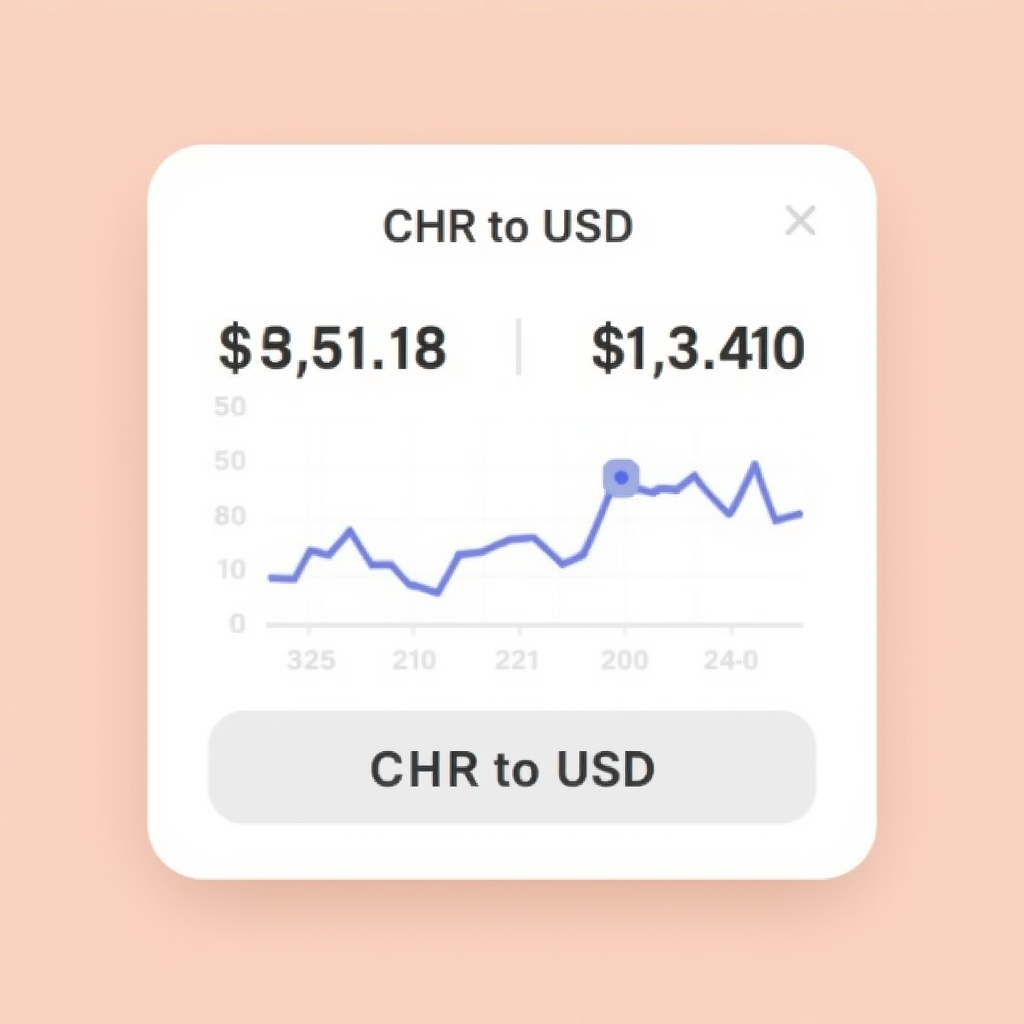
To get accurate chr to usd quotes, use multiple sources: major price aggregators, exchange tickers, and on-chain DEX pair explorers. Reliable sources include CoinMarketCap, CoinGecko, and the tickers on exchanges where CHR is listed. For real-time trading, check the exchange order book directly because aggregators can lag a few seconds. If you plan to sell CHR for USD, open the exchange’s BID/ASK spread and recent trade history to estimate execution price.
Best platforms to convert chr to usd (comparison)
Choosing the right platform depends on liquidity, fees, verification requirements, and whether you want bank withdrawal support. The table below compares common exchange categories and a few specific platforms that historically list CHR or support CHR trading pairs (availability may change — always verify current listings).
| Platform | Type | CHR Pairs | Pros | Cons |
|---|---|---|---|---|
| Binance | Centralized | CHR/USDT, CHR/BTC | High liquidity, low fees, fiat rails in many regions | Requires KYC, regional restrictions |
| KuCoin | Centralized | CHR/USDT | Wide altcoin selection, competitive fees | Fiat withdrawal options limited for some users |
| Gate.io | Centralized | CHR/USDT | Good altcoin listings | Usability can be complex for beginners |
| Uniswap / AMM | Decentralized | CHR/ETH (wrapped) | No KYC, direct wallet swaps | Higher slippage, gas fees, may require bridging |
For converting CHR to USD specifically, centralized exchanges with USD fiat rails (bank transfers, stablecoin conversions with easy withdrawal) are usually the fastest route for getting USD in your bank account.
Step-by-step: convert chr to usd on a centralized exchange
Below is a clear, numbered workflow to move from CHR in your wallet to USD in your bank account. Adjust steps for the exchange you choose, and always double-check addresses and network compatibility.
1.Create and verify an account on an exchange that lists CHR and supports USD withdrawals (e.g., Binance, if available in your region).
2.Deposit CHR from your wallet to the exchange deposit address. Confirm network (ERC-20 vs native) before sending.
3.Wait for confirmations and check your exchange balance for CHR.
4.Sell CHR on the spot market for USD or a USD-stablecoin (USDT/USDC). Use a market order for speed or a limit order to target a better price.
5.Withdraw USD to your bank via the exchange’s fiat withdrawal options (ACH, SEPA, wire). Alternatively withdraw USDT/USDC to a stablecoin-friendly service that supports fiat conversion.
6.Record the transaction details for tax purposes: date, amount of CHR sold, USD received, fees paid.

Using decentralized exchanges and liquidity pools
Decentralized exchanges (AMMs) offer a non-custodial path to swap CHR for another token like ETH or a stablecoin, which you can then bridge or sell for USD. This route avoids exchange KYC but adds complexity: you’ll need a compatible wallet, ETH for gas (or the chain’s native token), and awareness of liquidity depth. For example, CHR might be paired with wrapped ETH or a stablecoin on a DEX — check pool liquidity to avoid heavy slippage. After swapping to USDC/USDT, you can transfer stablecoins to a fiat-friendly centralized exchange or a crypto-friendly payment service to cash out to USD.
Fees, slippage and timing considerations
Three cost components affect the final chr to usd amount: trading fees, network/withdrawal fees, and price slippage. Trading fees vary by exchange tier but commonly range from 0.1% to 0.2% for makers/takers on big exchanges; DEX swaps add a protocol fee and gas. Slippage depends on order size vs market depth — large market sells can push the price down. Timing matters: try to avoid converting during low-liquidity hours or when markets are volatile after major news.
- Trading fees: check maker/taker schedule on the exchange.
- Network fees: ERC-20 transfers have gas costs; native chain transfers may be cheaper.
- Slippage: set a slippage tolerance on DEXs or use limit orders on CEXs to control execution price.
Tax and reporting when selling CHR for USD
Selling CHR for USD is a taxable event in many jurisdictions. Typically, you’ll realize capital gains or losses equal to the difference between your cost basis (what you paid for CHR) and the USD proceeds at the time of sale. Keep accurate records: timestamps, transaction hashes, amounts of CHR and USD, and fees. If you convert CHR to another crypto first (e.g., CHR -> USDT -> USD), each swap can be a taxable event depending on local rules. Consult a tax professional and use crypto tax software to automate reporting.
| Action | Tax implication |
|---|---|
| Sell CHR directly for USD | Capital gain/loss realized at sale |
| Swap CHR for stablecoin | May be taxable as disposition (jurisdiction-dependent) |
| Transfer CHR between personal wallets | Typically not taxable if you control both wallets |
Security tips and common mistakes when converting chr to usd
Security and attention to detail prevent costly errors. Double-check deposit addresses and network compatibility; sending tokens on the wrong chain can result in permanent loss. Enable two-factor authentication (2FA), use strong unique passwords, and consider hardware wallets for long-term CHR storage. Avoid public Wi-Fi when handling private keys or performing large transfers. Common mistakes include selling without checking fees, not accounting for tax, and withdrawing to an unsupported fiat payment method.
Practical checklist:
-Verify exchange listing for CHR and supported withdrawal methods.
-Confirm network (ERC-20 vs other) before deposits.
-Estimate total costs: trading fee + network fee + withdrawal fee + tax.
-Keep records and enable security features on your exchange account.
Common mistakes and final notes on chr to usd
Many users underestimate slippage and overpay in network fees or rush into the first available exchange. Others forget that stablecoins received on a DEX still need an on-ramp to fiat. Always compare the effective USD you’ll receive after all fees and taxes. If you’re a frequent trader, consider tiered fee discounts or a liquidity strategy to minimize market impact. For long-term holders, track project updates—fundamental changes to Chromia or broader crypto regulation can materially affect the chr to usd rate.
Use a blend of price-tracking tools, reputable exchanges, and cautious execution to convert CHR to USD efficiently. Keeping security, fees, and taxes front of mind will help you maximize proceeds and avoid surprises when converting your crypto into fiat.
FAQ
What is CHR and how does CHR to USD conversion work?
CHR is the native token of the Chromia ecosystem. CHR to USD conversion is simply the market price of one CHR expressed in US dollars at a given time; to convert an amount multiply the number of CHR by the current CHR/USD price quoted on an exchange or price aggregator.
Where can I find the live CHR to USD price?
Live CHR/USD prices are available on price aggregators like CoinGecko and CoinMarketCap, on major crypto exchanges where CHR trades, and in many portfolio apps and trading terminals. Always use multiple sources if you need accurate real-time quotes.
How do I convert CHR to USD on an exchange?
Sell CHR for a USD trading pair (e.g., CHR/USD) or for a stablecoin (USDT, USDC) and then withdraw fiat. On decentralized exchanges you’d swap CHR for a stablecoin and then use a fiat on-ramp. Expect trading fees, withdrawal fees, and possible KYC when cashing out to bank.
How do I calculate CHR to USD manually?
Find the current CHR/USD price, then multiply: USD value = CHR amount × CHR price in USD. Example: 50 CHR × $0.30 = $15. Adjust for exchange fees or slippage if trading.
What affects the CHR to USD exchange rate?
Supply and demand, liquidity on exchanges, project news and partnerships, broader crypto market trends, regulatory developments, tokenomics (circulating supply/token unlocks), and macroeconomic conditions all influence the CHR/USD rate.
Is CHR to USD conversion available 24/7?
Yes. Cryptocurrency markets operate 24/7, so CHR/USD prices update continuously. Fiat rails (bank transfers, fiat withdrawals) follow banking hours and can introduce delays when converting to or from USD bank accounts.
How accurate are CHR to USD price aggregators?
Aggregators give good market snapshots by averaging prices across exchanges, but slight differences exist because of varying liquidity and spreads. For trading, check the price on the specific exchange you’ll use.
Do I pay taxes when converting CHR to USD?
In many jurisdictions, converting crypto to fiat or using crypto to buy goods is a taxable event (capital gains). Tax rules vary by country; keep records of transaction dates, amounts, and USD values and consult a tax professional.
What are typical fees when converting CHR to USD?
Fees include exchange trading fees, withdrawal fees, network (blockchain) fees, and possible banking fees when withdrawing USD. DEX swaps also incur liquidity provider fees and slippage. Compare platforms to minimize costs.
Can I set price alerts for CHR to USD?
Yes. Most price aggregator apps, exchanges, and portfolio managers let you set alerts for CHR/USD price thresholds, percentage moves, or volume spikes to notify you in real time.
How liquid is the CHR to USD market?
Liquidity depends on which exchanges list CHR and the trading volume on those platforms. Some centralized exchanges have deeper order books for CHR, while smaller venues may have higher spreads and more slippage.
How do I track historical CHR to USD performance?
Use charting tools on CoinGecko, CoinMarketCap, trading platforms, or charting software. You can view historical prices, market cap, volume, and drawdowns over different timeframes.
Can I use CHR to pay directly for goods priced in USD?
Only if the merchant accepts CHR. Most merchants accept USD or stablecoins; using CHR typically requires a payment processor that supports the token or converting CHR to USD/stablecoin first.
Is CHR to USD a good short-term trading instrument?
CHR can be traded short term but tends to be more volatile than USD. Short-term trading requires understanding liquidity, risk management, fees, and using limit orders to control slippage.
What security precautions should I take when converting CHR to USD?
Use reputable exchanges, enable two-factor authentication, verify withdrawal addresses carefully, avoid phishing links, and keep private keys/private seed phrases offline for non-custodial wallets.
How do market caps and supply affect the CHR to USD price?
Market cap (price × circulating supply) gives size context; a larger circulating supply generally means each token represents a smaller slice of total value, and sudden token unlocks can increase sell pressure and affect price.
Where can I store CHR before converting to USD?
Store CHR in wallets supported by Chromia-compatible technologies or in exchange custodial wallets if you plan to trade. For long-term holding, prefer reputable hardware or secure non-custodial wallets.
How long does it take to convert CHR to USD and withdraw to a bank?
On-chain swaps are near-instant (seconds to minutes) but exchange settlement, verification, and fiat withdrawals to a bank can take from minutes to several business days depending on the platform and jurisdiction.
Can I convert part of my CHR holdings to USD and keep the rest?
Yes. You can execute multiple trades: sell a portion of your CHR for USD or stablecoins and retain the remainder in your wallet or exchange account.
How reliable are CHR to USD price predictions?
Price predictions are speculative. Analysts may use technical or fundamental analysis, but crypto markets are highly volatile. Treat predictions as hypotheses, not guarantees, and manage position sizes and risk accordingly.
Why might CHR show different USD prices on two exchanges?
Differences arise from varying liquidity, order book depth, fees, latency, and regional demand. Large buy/sell orders can move price more on low-liquidity exchanges, causing discrepancies.
Which is more stable: CHR or USD?
USD is a fiat currency with stable purchasing power relative to CHR, which is a volatile crypto token. If stability is your goal, USD or USD-pegged stablecoins are far steadier than CHR.
Which has higher volatility: CHR or USD?
CHR has much higher volatility. USD volatility is governed by fiat monetary policy and is relatively stable day-to-day; CHR’s price can swing significantly in short periods.
Which is better for daily transactions: CHR or USD?
USD is more practical for everyday transactions due to wide acceptance and stability. CHR can be used where accepted but may expose both buyer and seller to conversion risk from price swings.
Which offers better long-term value preservation: CHR or USD?
USD preserves short-term purchasing power with inflation risk managed by policy; CHR could appreciate or depreciate significantly. CHR is higher risk/high reward, not a conservative store of value like fiat savings or diversified assets.
Which is more liquid: CHR vs USD?
USD is the most liquid fiat globally. CHR liquidity depends on exchange listings and trading volume; it’s generally less liquid than USD, especially for large-order executions.
Which has more regulatory clarity: CHR or USD?
USD is a regulated fiat currency with clear legal frameworks. CHR, like many tokens, faces evolving regulatory treatment that varies by country and can affect trading and custody.
Which is easier to price and compare across markets: CHR or USD?
USD pricing is standardized across fiat markets. CHR price varies across crypto markets, so use aggregators or specific exchange order books to compare accurately.
Which is better for hedging crypto risk: converting CHR to USD or to a stablecoin?
Converting to USD offers fiat settlement but can be slower and involve banking constraints; stablecoins (USDT, USDC) provide near-instant crypto-native hedging with lower withdrawal friction, though they carry issuer risk.
Which is more suitable for a high-risk investment portfolio: CHR or USD?
CHR is suitable for higher-risk crypto allocations seeking growth; USD is suitable for capital preservation. Choose allocation based on risk tolerance and investment horizon.
Which tends to have higher transaction costs when moving value: CHR or USD?
Moving CHR on-chain entails blockchain fees; withdrawing USD from exchanges incurs banking fees and potential conversion expenses. Costs vary—small token transfers can be cheap, but fiat withdrawals often cost more in time and fees.
How do market hours affect CHR vs USD trading?
CHR trades 24/7 globally without market open/close times. USD banking operations are limited to banking hours and business days, which can delay fiat withdrawals and deposits.
Which is better for tax reporting ease: holding CHR or USD?
USD holdings simplify tax reporting if your income and tax system are fiat-based. Crypto holdings like CHR require detailed transaction records and often additional calculations for capital gains, increasing reporting complexity.
Can holding CHR instead of USD provide higher returns?
Potentially, because CHR can appreciate significantly. It also carries higher downside risk. A higher expected return comes with higher volatility and the possibility of substantial loss.
Is it safer to store wealth in CHR or USD during market turmoil?
During market turmoil, USD and other established fiat currencies are typically safer due to lower volatility and monetary controls. CHR can either rally or crash depending on market sentiment and liquidity.
How do acceptance and usability compare between CHR and USD?
USD is widely accepted for goods, services, and financial instruments. CHR acceptance is limited to crypto-native services and any merchants or platforms that explicitly support it; broader usability is much lower.
How should I decide between converting CHR to USD now or holding CHR longer?
Consider factors such as your investment horizon, risk tolerance, tax implications, current price relative to your cost basis, upcoming project catalysts, and liquidity needs. Use a plan (stop-loss/take-profit) rather than reacting solely to short-term movements.